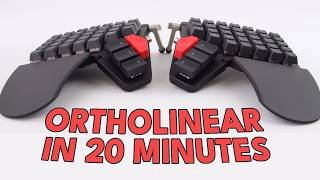
How I Plan to BEAT AI ANXIETY by Building a Keyboard Business!
A ChatGPT answer sent Lewis into an existential spiral about human value in an AI world. Here's how he found his way out — and why it led him to start a keyboard company.
Key Takeaways
- AI anxiety is common but rarely talked about — that creeping feeling that if AI can do it better, what's the point of you?
- The initial joy of AI (the 'tingle') gives way to the Gloom: questioning your own value when a tool outperforms you at almost everything
- What AI can't do: have a vision, wake up with an itch to make something, or care whether the thing it made gets used. Building is fundamentally human.
- The bottleneck in an AI world isn't capability anymore — it's execution. The people who actually sit down and build things matter more, not less.
- The dread goes away when you build something. Not when you learn more, consume smarter content, or get better at prompting — when you make something that wasn't there before.
- This insight is why InputZen exists: keyboards built specifically for people who ship things, not just people who scroll.
Need to Complete High-Quality Creative Work Fast?
We're obsessed with making tools that help you FLY THROUGH your creative work! If you want to produce more quality creative work then you ever have before, then drop your email below and get exclusive first access to new products we launch, at HUGE discounts, all dedicated to helping you Complete Creative Work Faster
Full Transcript
So, I was having a thought the other day while I was using chat GPT where put simply, the answer it gave to one of my prompts was so good that it basically sent me into an existential spiral. There’s probably a scientific term for this like AI anxiety or AI replacement dread. And I think it’s way more common than people admit. Maybe you’ve experienced it. Now, I think I may have found a way out of that spiral and it led me to start a business, but we’ll get there.
I remember logging on to AOL in the early days of the consumer internet. Every time I switched on the beige box and the giant CRT monitor, then went through the zen process of hearing that modem sound connecting to the worldwide web through dialup. There was always a like a little tingle of joy. It was like the bliss of endless possibility that you might remember from childhood. Maybe for you it was hitting or kicking a ball on a sports field or lifting up the cover to reveal piano keys or even just grabbing your favorite toy in preparation for an epic play session. But for me, it was that dial-up tone. It evoked this feeling of I’m about to discover something cool. I usually didn’t know what, but I knew for certain I was going to step into the web world and feel a little touch of amazement.
Within the last few years, I had a flashback to this sensation exactly twice. Once when I tried out Chat GPT for the first time and once again when I unwrapped my 3D printer. The 3D printing journey is a whole separate story. I’ll probably share that in another video sometime. But that first time experiencing AI in such a straightforward and responsive way, oh man, that was something special. It started with the very fast realization that I could now answer nearly any question at a speed and level of depth that just wasn’t possible before. I pride myself on my Google Ninja skills, searching my way out of most technical problems and challenges in my life. But Chat GPT could cut down hours or days of research into one clean answer. And it was able to understand how that answer would be best understood and used for my specific way of thinking. This was huge. The tingle was back. But this time, it wasn’t discovery I was excited about. It was learning and understanding practically anything in record time that seemed infinitely possible.
After wedging AI into every area of my life, I figured out I could build so much more with the help of AI. Code, websites, hardware, designs, online content, art, all of it. Building now seemed easier than I could ever have imagined in the before times when we didn’t have easy access to these powerful AI tools.
But then the gloom arrived. Here’s what nobody warned me about. After months of using AI for everything after that initial euphoria wore off, I started to feel something else. Something a little uncomfortable. If Chat GPT can answer any question better than I can, what’s the point of me even knowing things? If it can write code, explain concepts, solve problems at a level I’ll never reach, what exactly is my value? The answer Chat GPT gave made me question the value of human knowledge and brain power in the face of a tool that has an infinite memory, a never-ending knowledge base and near-perfect recall.
But that led to another thought, a question that I couldn’t stop turning over in my head. What can AI not do that human beings can? And here’s where it gets interesting. I started paying attention to what actually gave me satisfaction. Not the knowing, not the researching, not even really the problem solving. It was the building. The act of taking something that didn’t exist and making it exist, shipping it into the world, putting my name on it.
AI can answer questions. AI can generate options. AI can even create drafts and prototypes. But AI doesn’t really build. Not really. AI doesn’t have a vision it’s trying to bring to life. It doesn’t wake up with like an itch to make something specific. It doesn’t care if the thing it made gets used or just ignored. Building — the intentional act of creating something new and original and putting it into the world — is fundamentally human.
Which brings me to keyboards. And yes, I know that might seem like a weird pivot, but stick with me. Think about how much of what you build happens through a keyboard. Code, emails, documents, designs, messages that maintain relationships, words that become articles, scripts, businesses. Every builder I know — programmers, designers, writers, entrepreneurs — they all spend hours every day with their fingers on keys translating thoughts into reality.
And here’s the thing I realized. AI amplifies what you put into it. But someone has to put something in. Someone has to have the vision. Someone has to sit down and actually build. The humans who build things, who ship, who create, who execute — those are the people who matter in an AI world. Maybe they matter more now than they did before. Because AI has made the gap between having an idea and building the thing smaller than ever. Which means the bottleneck isn’t capability anymore. It’s execution. It’s actually doing it.
That’s why I’m building InputZen — keyboards for builders. Tools specifically crafted for people who don’t just consume but create, who don’t just scroll, but ship.
So back to that existential spiral. The answer Chat GPT gave me that day, the one that made me question everything. I don’t even really remember what it was about anymore. But I remember what it made me realize. The dread goes away when you build something. Not when you learn something new, not when you consume smarter content. Not even when you get better at prompting AI. The dread goes away when you sit down, put your hands on a keyboard, and make something that wasn’t there before. AI can’t take that from you. It can only help you do it faster.
If you’re feeling that AI anxiety, that creeping sense that maybe you’re becoming obsolete, I have one suggestion. Build something. It doesn’t have to be a business. It could be a side project, a piece of code, a video, a design, something that has your fingerprints on it.
That’s what this channel is going to be about. Keyboards, yes, but more than that — building the tools, the mindset, the process. I’m documenting my journey building InputZen publicly. The wins, the failures, all of it. If that sounds interesting, you should definitely subscribe and like this video while you’re at it. And if you’re a builder or you want to become one, I’d love to hear what you’re working on. Drop a comment down below. And until next time, stay zen.